Comet's Chemical Clues: NASA Just Hit Paydirt

Comet's Chemical Clues: NASA Just Hit Paydirt

Alex Chen
Alex Chen

Senior Tech Editor

·Updated 4d ago·4 min read·802 words
cometorganicnasaspacecosmic
Share:

Comet's Chemical Clues: NASA Just Hit Paydirt

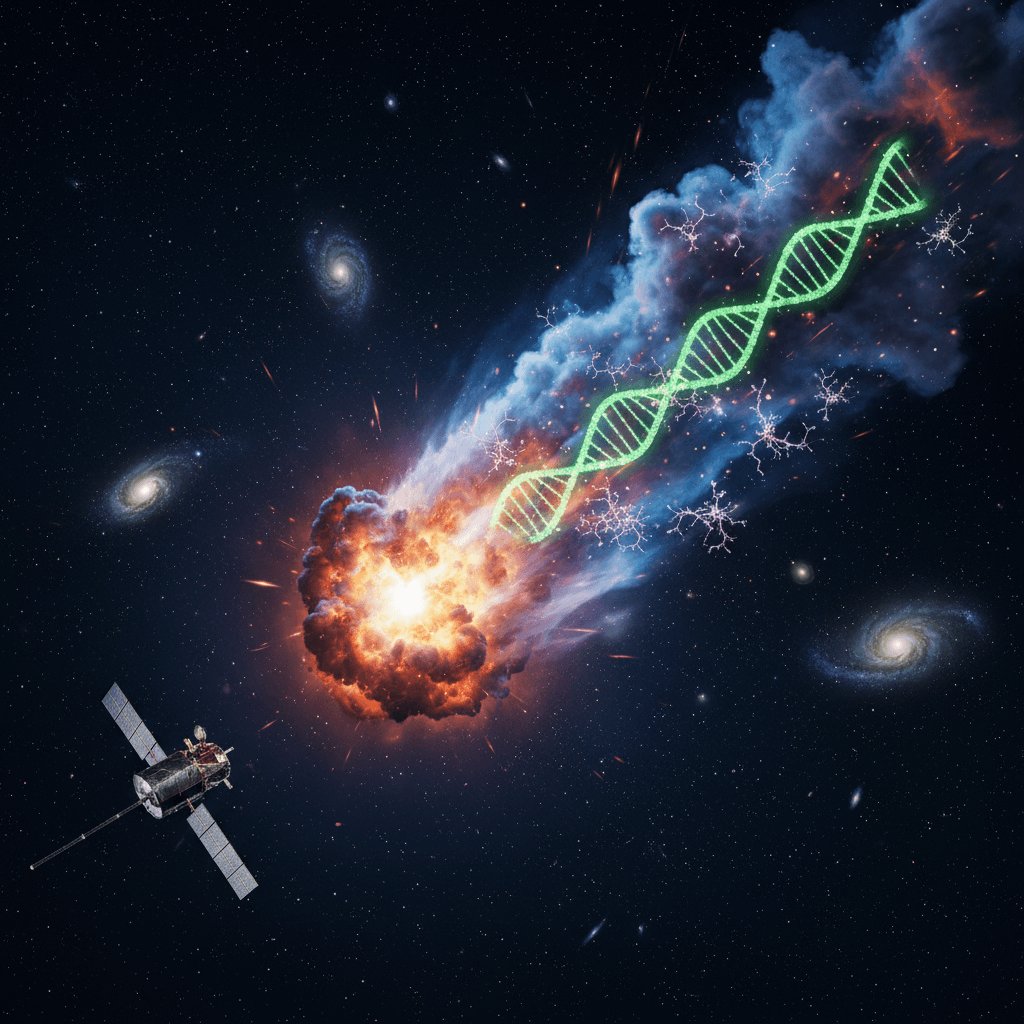
Another day, another space headline. I'll admit, I usually roll my eyes, muttering about asteroid near-misses that are "closer than the moon!" but still millions of miles away. But this one? This NASA announcement about a comet that essentially blew its top millions of miles out in the void—it actually got my attention. And not just mine; social media is alight, and news desks are scrambling. Why? Because what came out of that cosmic burp wasn't just dust and ice. It was the good stuff: organic chemicals. Yes, the kind that make you wonder if the universe has been trying to send us a very clear, very cold message about where we all came from.

You see, this isn’t just a pretty picture for our Hubble-hungry feeds. We’re talking about data coming back from NASA that's being called "revolutionary." Revolutionary. That’s a word I hear a lot in Silicon Valley—usually attached to an app that delivers lukewarm coffee. But here, with a comet ejecting a complex cocktail of organic compounds into deep space? That’s revolutionary in a way that actually, genuinely, fundamentally shifts things. It's trending not because it's flashy, but because it taps into the oldest, most profound bug report humanity has ever filed: "What's the origin story?" People are hitting search engines harder than I hit refresh during a server meltdown, looking for "organic chemicals in space" and "NASA comet explosion." The Daily Galaxy even suggests this might be the strongest evidence yet for panspermia-lite—the idea that life's fundamental Lego bricks hitched a ride on space rocks to kickstart things here on Earth. If true, that’s a hell of a delivery service.

So, What's an "Exploding" Comet, Really?

Let's clear up the Hollywood version of an explosion. We're not talking about some Michael Bay-esque fireball. Comets are, at their core, glorified dirty snowballs—relics from the early solar system, basically frozen primordial soup. As one of these ancient icy chunks (NASA tells us this one’s from way back, 4.6 billion years) cruises too close to the sun, its ice doesn't just melt; it sublimates. Think dry ice, but on a truly astronomical scale. This rapid transition from solid to gas can build up insane internal pressure. And when that pressure hits its breaking point? You get an "outburst"—a violent expulsion of material, a natural space geyser. In this case, a massive one.


The real magic happened when NASA pointed its high-resolution spectroscopy at the ejected material. For those of you who aren't familiar with space-age lab equipment—it's essentially a cosmic fingerprint scanner. And the fingerprints it found were wild. We're talking high concentrations of carbon-based molecules: methanol, ethane, and other complex hydrocarbons. If you've ever debugged a protein folding simulation at 2 AM, you know these aren't just random atomic jumbles. These are the foundational elements, the very source code, for life as we know it.

"Organic" Doesn't Mean "Alien Dinner Party"

Before you start picturing little green men building homes out of comet debris, let's pump the brakes. There's a crucial distinction here that seems to confuse half the internet every time this comes up. When scientists say "organic," they're not necessarily talking about living organisms or even biological byproducts in the way your kale smoothie is "organic." In chemistry, "organic" simply means compounds containing carbon atoms, often bonded with hydrogen, oxygen, or nitrogen. These are the building blocks, the raw materials. Think of it like finding a pile of lumber and nails. You don't have a house yet, but you've got everything you need to start building one. The comet didn't just cough up some dirt; it ejected raw, potential life. If you want the deep dive, hit up Wikipedia's organic compound page. It’s dense, but worth it.

(Side note: I've sat through enough product launches promising "game-changing" new features that are essentially re-skinned old ideas. This comet, though? This is actually changing the game, or at least how we think the game started. It's a reminder that the biggest innovations aren't always in our data centers but floating around in the cold, dark, incredibly interesting parts of the universe. It makes you wonder what else is out there, waiting for its big reveal.

So, is this the definitive answer to how life began? Probably not, because science rarely works with definitive, single answers. It’s more like a constantly evolving software project with endless patches and updates. But this discovery is a massive patch, a crucial piece of the cosmic puzzle. It adds significant weight to the argument that Earth wasn't some pristine, isolated incubator, but rather a recipient of ingredients delivered from the stars. It forces us to reconsider the cosmic shipping manifest—and that, for an old tech editor who’s seen it all, is genuinely exciting.

Related Articles