The $2 Trillion Panic: Why Alphabet’s 22% Dip is a Gift

The $2 Trillion Panic: Why Alphabet’s 22% Dip is a Gift

Alex Chen
Alex Chen

Senior Tech Editor

·Updated 4d ago·6 min read·1163 words
googlesearchactuallybillionalphabet
Share:

I remember sitting in a windowless briefing room in Mountain View back in 2016 when Google first announced they were an "AI-first" company. Most of us in the tech press corps just nodded, wrote our 500-word summaries, and went looking for the free espresso. We’d heard it all before. But looking at the charts today, it seems the market has suddenly decided that "AI-first" actually means "AI-victim."

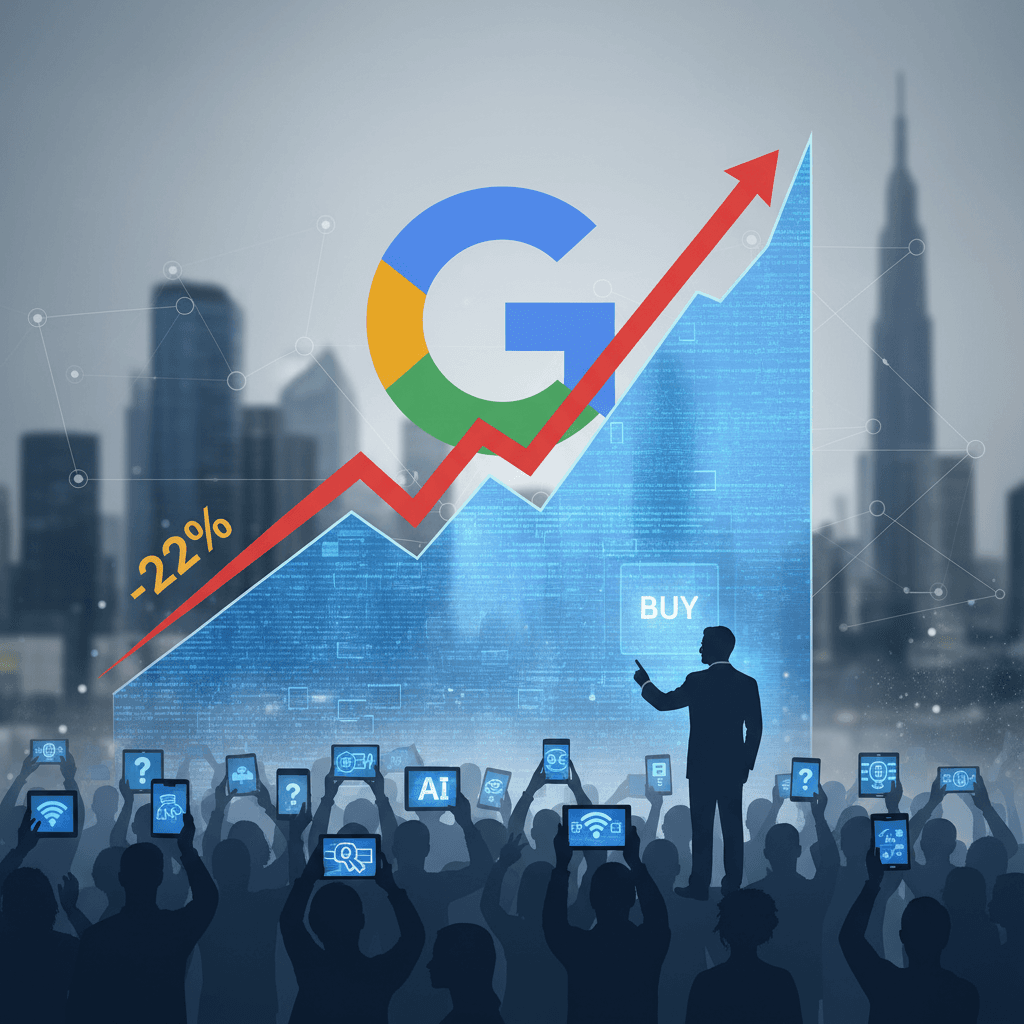
Alphabet (GOOGL) is currently sitting about 22% off its recent highs. For a company that essentially owns the front door to the internet, that’s not just a correction; it’s a fire sale driven by pure, unadulterated nerves. The narrative is simple: ChatGPT and Perplexity are going to eat Google’s lunch because "nobody wants to click links anymore."

I’ve spent fifteen years watching these "existential threats" dissolve. I remember when "Social Search" via Facebook was going to kill Google. Then "Mobile Apps" were going to silo the web and make search obsolete. Neither happened. Here’s why the current 22% discount is the most obvious buying opportunity in the Magnificent Seven right now.

The "Death of Search" is a Bored VC's Fantasy

The bears love to talk about the "LLM threat." They argue that because I can ask OpenAI's o1 model to plan a 7-day trip to Tokyo, I’ll never use Google again. That’s a fundamental misunderstanding of human behavior. Most people aren't looking for a deep philosophical conversation with a chatbot; they’re looking for a plumber, a pair of Nike Dunks, or the name of that actor from that one show.

Google handles over 8.5 billion searches per day. According to Wikipedia, Google maintains a global search market share of roughly 90%. You don't just "disrupt" that level of muscle memory with a chat interface that occasionally hallucinates legal advice. The friction of switching is massive. My dad isn't going to start "prompt engineering" his grocery list.

But here's the real question: Why is the stock down? It’s the "Innovator’s Dilemma" fear. Investors are terrified that Google will cannibalize its own high-margin search ads to show AI-generated answers. It’s a valid concern if you’ve never actually looked at how Google makes money. They’ve been hiding ads in "featured snippets" for years. They'll do the same with AI.

By the Numbers: Why the Math Doesn't Care About Hype

Let’s look at the actual plumbing. In its last fiscal report, Alphabet showed that Google Cloud is finally a profit machine, growing 29% year-over-year. This isn't just a search company anymore; it's a massive infrastructure play. They have the custom silicon—the TPUs (Tensor Processing Units)—that make running these massive AI models actually affordable.

While startups are burning VC cash to rent H100s from Nvidia, Google is running on its own internal hardware. That is a massive, structural margin advantage that isn't reflected in a 22% price drop.

  • Forward P/E Ratio: Alphabet is trading at roughly 18x forward earnings. Compare that to Microsoft at 30x or Amazon at 40x.
  • Cash on Hand: They are sitting on over $90 billion in cash and marketable securities.
  • YouTube Revenue: YouTube ads are pulling in over $8 billion per quarter, and that doesn't even count the subscription revenue from YouTube TV.

Every time I hear a 24-year-old analyst say Google is "the next Yahoo," I want to show them the SEC filings. Yahoo didn't have a $30 billion-a-year cloud business or a video platform that 2 billion people use as their primary search engine.

Alex's Take: I’ve spent 2 AM sessions debugging code that relied on Google’s APIs. I can tell you from experience: the world is built on Google’s documentation and infrastructure. Replacing that isn't a "weekend project" for a startup; it's a decade-long siege that hasn't even begun.

The Angle Everyone is Missing: The Data Loop

The mainstream media is obsessed with the *interface* of AI. They’re missing the *data*. To train a world-class model, you need high-quality, real-time data. Google has the most valuable data set in human history: the "intent" data of what billions of people want at any given second.

When you use a third-party AI search tool, they are often just scraping the web or—ironically—paying for the Google Search API. Google gets the data for free. They own the browser (Chrome), the OS (Android), and the search engine. That feedback loop is an unbreakable moat.

Compared to the "pure-play" AI startups, Alphabet has a sustainable business model that funds its R&D. They don't need to raise a Series E to keep the lights on. This brings me to a contrarian point: The DOJ antitrust lawsuit might actually be a good thing for shareholders in the long run. Even if Google were forced to spin off Chrome or Android, the sum of the parts is arguably worth more than the current $2 trillion market cap. Just look at the Reuters reports on historical breakups like Standard Oil. Investors usually win.

The 2 AM Debugging Lesson

Years ago, I worked on a project where we tried to move our entire stack away from Google’s ecosystem because we were annoyed with a pricing change. It was a disaster. We spent three months trying to replicate the latency and reliability of their geolocation APIs before crawling back.

That’s the "sticky" factor people ignore. It’s not just about where you search for "best pizza near me." It’s about the millions of developers and businesses whose entire workflow is hardcoded into Google Cloud, Firebase, and Google Workspace. This isn't a "legacy" company. This is the foundation.

As I noted in my analysis of Google’s AI Warning, most startups are just thin wrappers around existing APIs. Google is the API.

The 2025 Forecast: The Rebound is Already Coded

So, where does this go? The 22% dip is a reaction to uncertainty, and the market hates uncertainty more than it hates bad news. But as Google integrates its "Search Generative Experience" (SGE) more deeply, and as those Cloud margins continue to expand, that uncertainty will evaporate.

My specific prediction: Within the next 12 to 18 months, Alphabet will hit a new all-time high, likely crossing the $210 per share mark. This will be driven by two things: a stabilization in search ad revenue as "AI-native" ads prove their ROI, and a massive buyback program fueled by that $90 billion cash pile.

If you’re a professional in the tech space, this signals that the "AI hype" is moving from the "wow, cool demo" phase to the "how do we actually make money" phase. In that second phase, the house always wins. And in this case, Google is the house.

The downstream effect I’m watching: The death of the "SEO-optimized" junk web. As Google’s AI starts answering basic queries directly, low-quality content farms will die off. This will actually increase the value of Google’s ad inventory because the remaining traffic will be higher intent. The "junk" goes away, the "value" stays. Buy the dip before the rest of the world realizes that the "Google Killer" was just a hallucination.

Related Articles