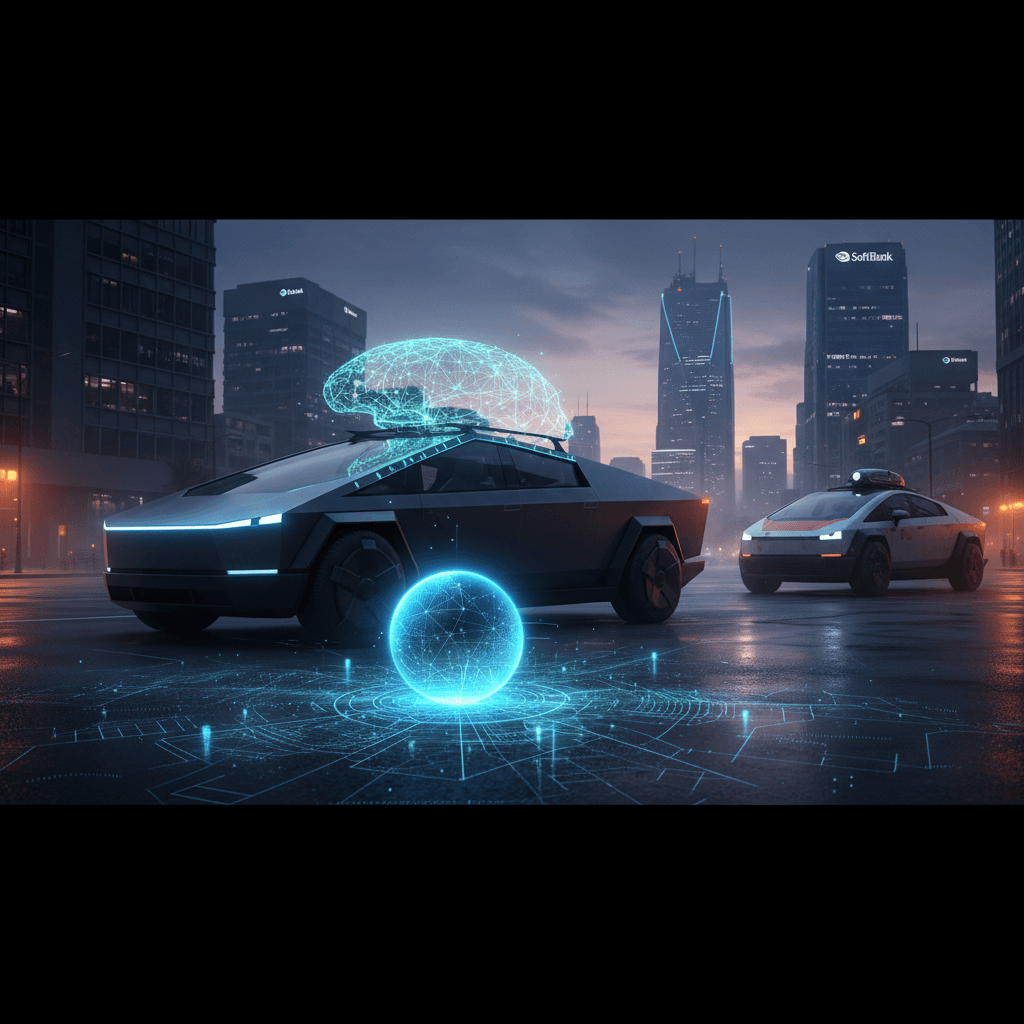
I’ve spent the last decade watching the self-driving car industry go through more "reborn" moments than a washed-up boy band. I remember the 2018 hype when every VC with a Patagonia vest thought we’d be napping in our Ubers by 2020. Then came the 2022 winter, where companies folded and "Level 5" became a punchline. But this morning’s news is different. London-based startup Wayve just pulled in $1.5 billion in Series C funding, and the names on the check—SoftBank, Nvidia, and Microsoft—suggest we are entering a fundamentally different phase of the robotaxi wars.
This isn't just another pile of cash to keep the lights on. It’s a massive bet on a philosophy that says everything Google’s Waymo and GM’s Cruise have been doing for ten years is fundamentally flawed. If you’re tired of hearing about AI "changing the world," I get it. I’ve sat through enough 2:00 AM debugging sessions and vapid product launches to be a professional skeptic. But Wayve’s "Embodied AI" approach is the first thing in years that actually feels like a breakthrough rather than an incremental patch.
The End of the Digital Crutch
To understand why Wayve is getting $1.5 billion while others are starving, you have to look at how self-driving cars actually "see." Most players, including the industry leader Waymo, rely on high-definition (HD) maps. These are essentially digital crutches. Before a Waymo car can drive in Phoenix, Google has to map every single curb, stop sign, and lane line with centimeter-level precision. It’s expensive, it’s brittle, and it doesn't scale. If a construction crew moves a cone six inches to the left, the car can have a nervous breakdown.
Wayve is doing something much closer to how you and I drive. They use "mapless" end-to-end deep learning. According to Reuters, this approach allows the vehicle to navigate purely based on visual input and reinforcement learning. It’s basically GPT-4, but for physics. Instead of following a pre-written script of the city, the AI "understands" the concept of a road. It generalizes. This is why the The $1.5B Bet Proving Everything We Knew About Self-Driving Was Wrong is such a massive deal—it’s a pivot from "follow the map" to "understand the world."
The Power Players at the Table
Look at who is funding this. SoftBank is leading the round, which usually makes me reach for my wallet in fear (never forget WeWork). But they are joined by Nvidia and Microsoft. This is the "AI Holy Trinity." Nvidia provides the silicon, Microsoft provides the Azure cloud for training, and SoftBank provides the raw capital. $1.5 billion is a staggering amount of money for a company that doesn't have a massive fleet on the road yet, but in the context of autonomous vehicle development, it's just the table stakes for the next round of the game.
- SoftBank’s Vision Fund 2 is trying to redeem its reputation by backing "real" AI.
- Nvidia wants to ensure their chips are the brains of every robot on wheels.
- Microsoft is looking to lock in the massive compute credits Wayve will need to train these models.
Alex’s Take: Let’s be real—this is a direct shot at Tesla’s FSD (Full Self-Driving). Elon has been preaching the "vision-only, no-map" gospel for years, but he’s doing it in a closed ecosystem. Wayve is building the "Android" of self-driving. They want to license this brain to every automaker that realized too late they can’t write software to save their lives. It’s a brilliant, high-risk play.
Why This Matters to You (Even if You Hate AI)
So why should you care about a British startup getting a billion-dollar haircut? Because the "map-based" approach was never going to work in 90% of the world. It works in sunny, grid-based suburbs like Chandler, Arizona. It fails miserably in the chaotic, rain-slicked streets of London or the unmapped backroads of Vermont. If Wayve’s tech actually works, the "robotaxi" isn't a luxury service for Silicon Valley engineers—it becomes a scalable utility.
The numbers back up the urgency. The global autonomous vehicle market is projected to hit $2.1 trillion by 2030, according to reports from TechCrunch. But that money is currently locked behind a "scaling wall." You can't map the entire planet. You have to teach the cars to think. Wayve's model is trained on diverse data—different weather, different driving cultures—making it more resilient than a car that's only ever seen the sun-drenched asphalt of California.