The 2.8% Lie: The Brutal Truth About Your 2026 Wallet

The 2.8% Lie: The Brutal Truth About Your 2026 Wallet

DP
Daniel Park

Economy & Markets Editor

·6 min read·1246 words
inflationcostserviceseconomygoods
Share:

Your $9 Latte Is an Economic Warning Sign

I just paid $8.75 for a flat white in downtown Austin. That’s not a typo. And it’s not some artisanal coffee infused with unicorn tears. It’s just… coffee. And that single, infuriating purchase tells you everything you need to know about the economy in March 2026.

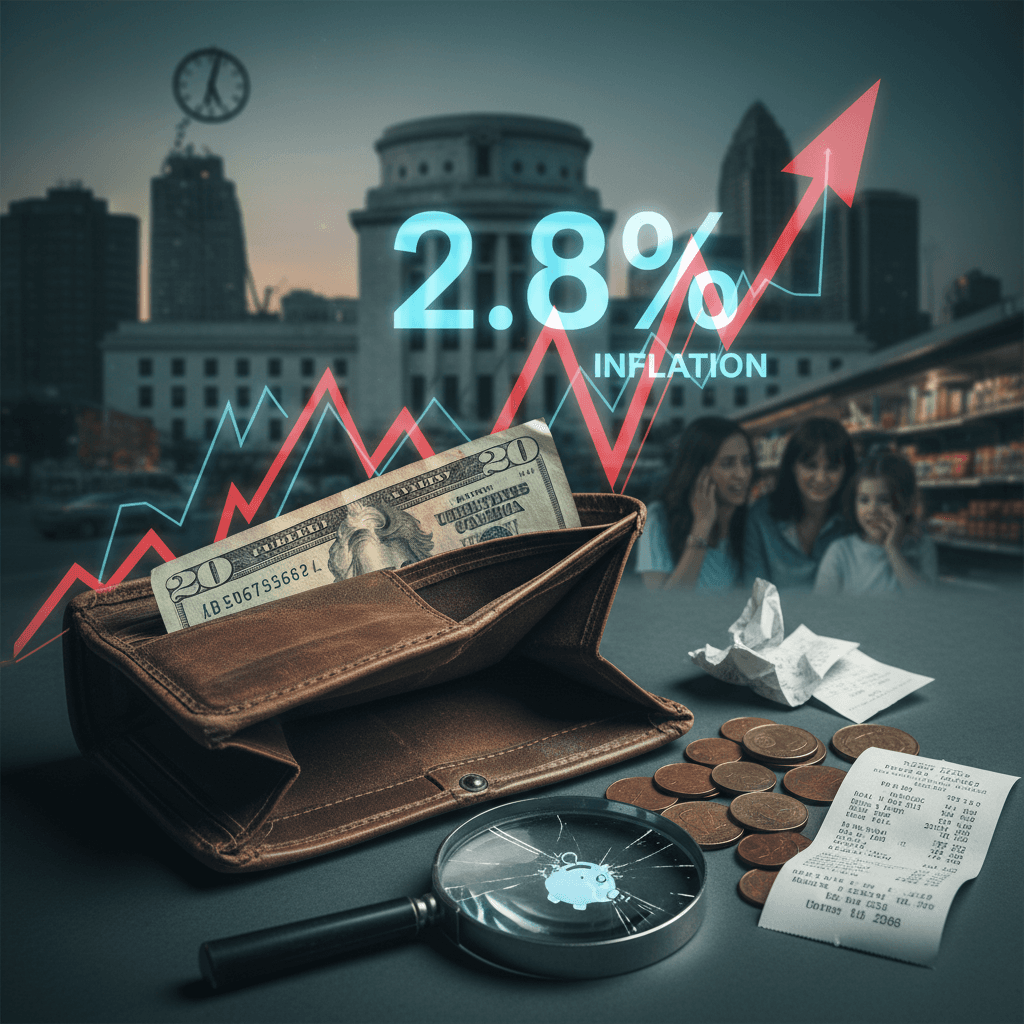
The official numbers, the ones the folks in Washington and on Wall Street wave around, look deceptively calm. The latest Consumer Price Index (CPI) report from the Bureau of Labor Statistics shows year-over-year inflation at 2.8%. A victory, right? The central bankers took their bow, declaring the post-pandemic inflation dragon slain. They popped the champagne back in late 2024 when the number first dipped below 3%.

Don’t fall for it. That 2.8% figure is one of the biggest lies in modern economics. It’s a statistical mirage that hides a brutal reality: for most people, the cost-of-living crisis never ended. It just changed its clothes.

So why does your bank account feel like it's been run through a woodchipper while the experts tell you everything is fine? Because we’re fighting two different inflations. And one of them is winning.

The Great Bifurcation: Goods vs. Services

Remember 2023 and 2024? The easy part of the inflation fight. Supply chains unsnarled. The price of that 70-inch TV you bought on a whim dropped. Used car prices, which had gone completely vertical, finally came back to earth. This was "goods disinflation," and it did most of the heavy lifting to bring that scary 9% inflation number from 2022 down to something more palatable.

The Federal Reserve took a victory lap. But I was telling anyone who would listen back then: popping the goods bubble is simple. The hard part is services. And that’s the bill that’s come due.

Let’s rip open that 2.8% headline number. Here’s what’s really going on under the hood as of March 2026:

  • Core Goods CPI: A sleepy -0.5% year-over-year. Your electronics, furniture, and clothes are actually getting a little cheaper.
  • Core Services CPI (ex-housing): A blistering 4.1%. This is the monster. This is your car insurance (up 18% YoY, by the way), that haircut, your internet bill, and yes, your $9 coffee.

This isn't a rounding error. It’s a fundamental split in the economy. The things you buy, often made in a factory overseas, are behaving. But the things you do—the services performed by people in your own country—are seeing relentless price hikes. And you can’t outsource a root canal or a plumbing repair.

Why Your Paycheck Buys Less and Less

The Federal Reserve is stuck. Their primary weapon—the federal funds rate, currently sitting at a stubborn 3.75%—is a blunt instrument. It's great at crushing demand for big-ticket items like houses and cars. It’s terrible at stopping your auto insurer from jacking up your premium because replacement parts and skilled labor costs are soaring.

The result? A two-track economy. If you own assets—stocks, real estate—you’ve been fine. The S&P 500 has been grinding higher, buoyed by AI-fueled tech earnings. But if you’re one of the 60% of Americans whose wealth is primarily tied to your salary, you’re falling behind. Wage growth is hovering around 3.5%, which means after you account for services inflation, your real purchasing power for the things you actually need every day is negative.

You’re getting a raise, but your lifestyle is getting downgraded. It’s a silent, insidious tax on living.

The Contrarian Angle: Deglobalization Is Permanent Inflation

Here’s the part the mainstream coverage keeps missing, because it’s politically inconvenient. They’re all still arguing about whether the Fed "did enough." That's the wrong question.

The real story is that the fundamental structure of the global economy has changed. For thirty years, from roughly 1990 to 2020, the West outsourced its inflation problem. We built hyper-efficient, just-in-time supply chains to factories in China and Southeast Asia, pushing down the cost of goods to absurdly low levels. That era is over. Dead and buried.

The combination of the pandemic, the war in Ukraine, and rising US-China tensions forced a reckoning. Now, the buzzword in every boardroom is "resilience," not "efficiency." That means reshoring, friend-shoring, and building redundant supply chains. It’s a smart move from a national security perspective. But it’s also wildly inflationary.

Building a semiconductor fab in Arizona is orders of magnitude more expensive than in Taiwan. It’s just a fact. That cost doesn’t vanish; it gets passed on to you in the price of your next phone, your car, and your cloud subscription. This isn't a temporary spike. This is a new, higher baseline cost for civilization.

Editor's Take: I spent eight years on the Street, and every model we built was based on the assumption of ever-increasing global trade and low-cost foreign labor. Those models are now useless. We are in a new regime, one that looks less like the deflationary 2010s and more like the volatile post-WWII era. The late 1940s saw huge pent-up demand and massive industrial re-tooling, leading to unpredictable inflation swings. Sound familiar? The Federal Reserve's obsession with a 2% inflation target is a nostalgic fantasy. In an era of geopolitical competition and decarbonization, the natural rate of inflation is likely closer to 3% or 3.5%. By refusing to admit this, they are sentencing us to years of unnecessarily tight monetary policy that punishes workers to protect a defunct economic theory.

The Road Ahead Is Not Getting Smoother

So where does this leave us? The market has priced in one, maybe two, more quarter-point rate cuts from the Fed by the end of 2026. I think that's optimistic. The stickiness of services inflation, particularly with a tight labor market, gives them zero room to maneuver.

The "soft landing" we were promised in 2024 has turned into a "bumpy, indefinite taxi on the runway." The plane isn’t crashing, but we’re not getting to our destination of stable, low-inflation growth either. We're just burning fuel and going nowhere fast.

This economic state has real consequences. Corporate CFOs I talk to are planning for a world where the cost of capital is permanently higher. That means less speculative R&D, more focus on immediate profitability, and fewer of the "moonshot" projects that defined the 2010s tech boom. The era of free money that funded a thousand unprofitable startups is ancient history.

As major financial outlets have reported, consumer debt levels are also creeping back up to all-time highs. People are using credit cards to plug the gap between their stagnant real wages and the rising cost of essential services. That’s not a sustainable path.

My Prediction: The Political Boiling Point Is Coming

Forget the economic models for a second. Here's the most critical impact that no one is pricing in.

The bifurcation of the economy—where asset owners thrive while wage earners get squeezed by non-discretionary service inflation—is politically explosive. You cannot have a society where the stock market is hitting new highs but a family of four can't afford to get their car fixed without going into debt. Not for long, anyway.

The downstream effect I'm watching for the next 18-24 months: This persistent, annoying inflation in essentials will become the number one driver of populist anger in both North America and Europe. It’s a more potent political force than immigration, cultural debates, or foreign policy. It’s the daily, grinding frustration of feeling like you’re working harder but falling further behind.

For professionals in tech and finance, this signals an urgent need to shift focus from growth-at-all

Related Articles