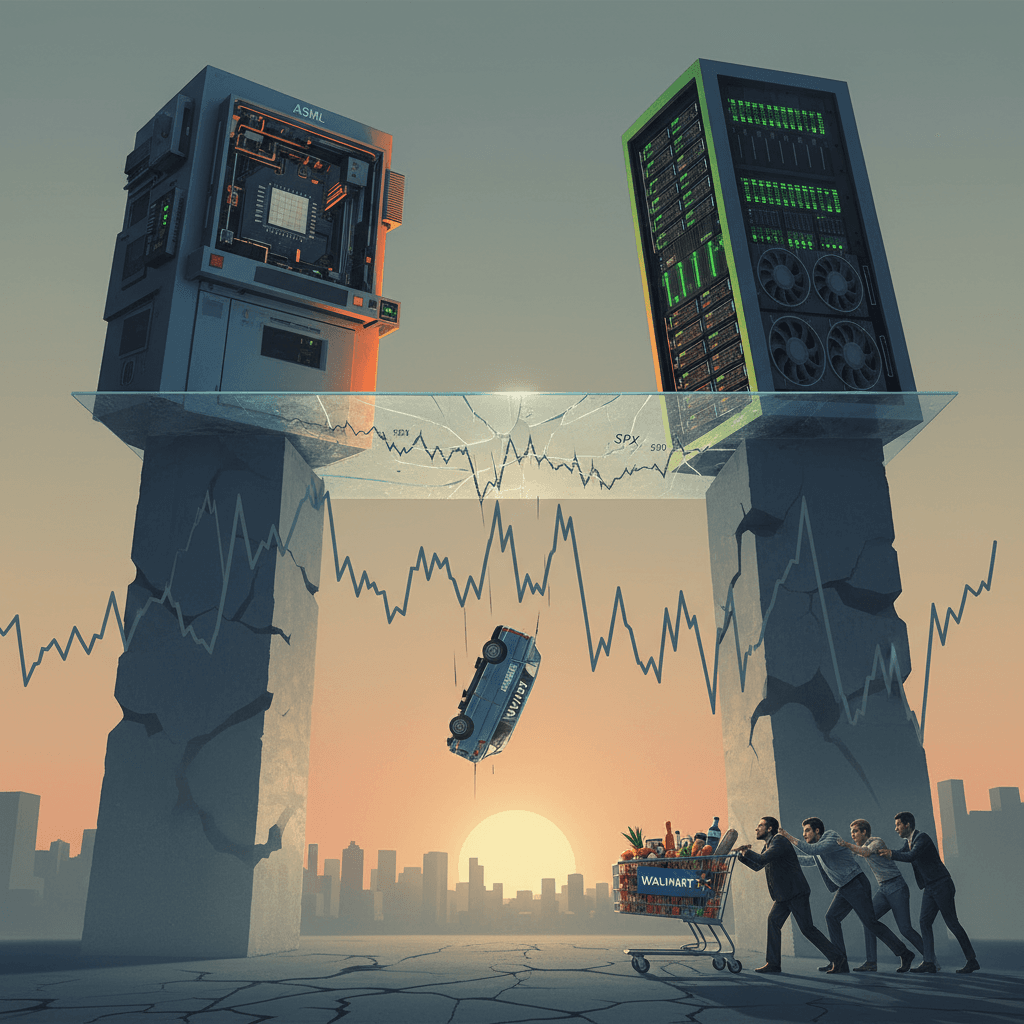
I’ve spent the better part of a decade watching the S&P 500 do its impression of a mountain climber with a heavy pack, but right now, it feels like the entire mountain is made of silicon. If you glance at the futures today, you’ll see the index bumping its head against a very specific glass ceiling—a resistance level that feels less like a technical chart pattern and more like a collective breath-holding exercise by every trader from Manhattan to Menlo Park. While the Investor's Business Daily reports show the indices ticking upward, the heavy lifting is being done by exactly two names: Nvidia and ASML. Everyone else is just trying not to fall off the cliff.
I remember sitting in a windowless room in 2014, trying to explain to a VC why hardware still mattered in a "software is eating the world" era. He laughed. Nobody is laughing now. Nvidia is currently sitting on a market cap of roughly $2.2 trillion, and ASML—the Dutch company that literally owns the monopoly on the machines that make the chips—is the quiet heartbeat of the entire global economy. But here is the real question: How long can two companies carry 498 others before the structural integrity of this rally gives way?
The Silicon Ceiling and the S&P 500
The S&P 500 is currently testing resistance near the 5,200 mark. In trader-speak, "resistance" is just a fancy way of saying "the price where people get nervous and start selling." I’ve seen this movie before. We saw it in 2021 before the inflation reality check hit us like a sack of bricks. The difference this time is the sheer concentration of power. When Nvidia moves 4% in a session, it doesn't just move a stock; it moves the needle for every pension fund in North America.
ASML is the one I’m actually watching, though. They produce the Extreme Ultraviolet (EUV) lithography machines. According to Wikipedia, these machines are the only way to manufacture chips at the 3nm and 2nm nodes. They cost about $350 million per unit. Think about that. One machine costs more than most Series C startups are worth. If ASML’s futures are rising, it means the big foundries—Intel, TSMC, Samsung—are still betting that the AI demand isn't a fluke. It’s a massive capital expenditure bet that we aren't at the top of the cycle yet.
The Carvana Divergence: A Warning Shot
While the chip gods are smiling, the "real world" economy is showing some nasty bruises. Carvana, the poster child for the "easy money" era of 2020, took a late-day dive, dropping nearly 8% in after-hours trading. This isn't just about used cars. It’s a signal about the American consumer’s credit health. I spent years debugging code for fintech platforms, and the one thing I learned is that when the subprime auto market starts to shake, the rest of the consumer discretionary sector is usually about six months behind.
The contrast is jarring. We are living in a bifurcated reality. On one side, you have the "Compute Class"—companies like Nvidia that are printing money by selling shovels to AI miners. On the other, you have companies like Carvana that are struggling with 7% interest rates and a consumer base that is finally tapped out. It’s a tale of two economies, and right now, the Compute Class is the only thing preventing a broader market correction.
Alex's Take: We are witnessing the "AI Tax" in real-time. Every dollar being funneled into H100 GPUs is a dollar being pulled out of traditional enterprise software, marketing budgets, and consumer goods. This isn't a "rising tide lifts all boats" scenario; it's a massive wealth transfer from the rest of the economy into the pockets of chip designers and power utilities.
Walmart and the "Vibecession" Reality Check
Tomorrow, Walmart reports earnings, and quite frankly, it matters more than Nvidia’s next keynote. Walmart is the ultimate data point for the "vibecession"—that weird state where the macro numbers look okay but everyone feels broke. If Walmart shows a beat driven by high-income shoppers "trading down" to buy groceries at a discount, it confirms that the middle class is hurting. We already saw hints of this in Reuters reports regarding recent retail sales data.