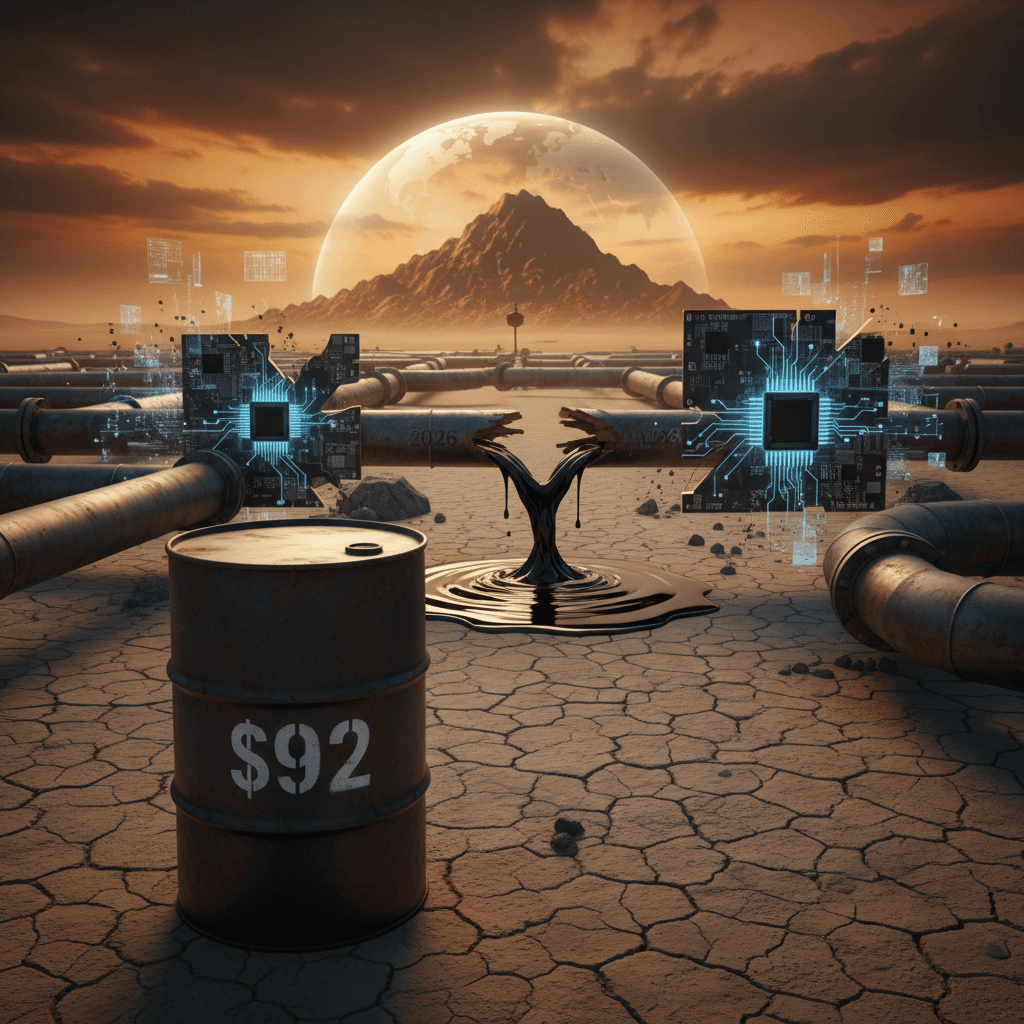
Oil Prices at $92: The Critical Supply Lie of 2026

Oil Prices at $92: The Critical Supply Lie of 2026

DP
Daniel Park

Economy & Markets Editor

·5 min read·933 words
marketbarrelpricepricesproduction
Share:

The announcement from Guyana’s Ministry of Natural Resources last week didn’t exactly break the internet. It was a dry, technical update about a two-week maintenance shutdown at an offshore platform. A rounding error. The market barely flinched. But sitting at my desk, watching the ticker, I felt that old knot in my stomach I used to get on the trading floor right before a position went sideways.

That tiny, insignificant production blip from a newcomer on the world stage is the whole story. It’s a market so precariously balanced that a few hundred thousand barrels temporarily offline in South America should have mattered. The fact that it didn’t tells me one thing: the market is complacent. It's high on the "energy transition" narrative and ignoring the brutal reality of how we power the globe in 2026.

Everyone is looking at the wrong numbers. And that complacency is about to cost us.

How Did We Get to a Tense $92 Barrel?

Let’s be clear: oil at $92 a barrel isn’t a random spike. It’s the result of a multi-year hangover from a decade of excess followed by a period of forced, painful discipline. For years, I watched US shale producers operate like tech startups—growth at any cost. They flooded the world with cheap oil, cratering prices and bankrupting anyone with too much leverage.

That party is over. The shale patch has found religion, and that religion is shareholder returns. They’re not chasing production records anymore; they’re chasing dividends and buybacks. The result? US production growth has slowed to a crawl, from a frantic 10-15% annually in the late 2010s to a sluggish 2% today. They are no longer the global swing producer that can instantly cool off prices.

Meanwhile, OPEC+ has been playing a masterful game. Led by Saudi Arabia, the cartel has maintained its tight grip on supply, learning the hard way from the 2020 price war that market share is worthless if the price is in the gutter. They’ve successfully kept a floor under the market, and as their recent communiqués show, they have zero intention of opening the taps just to make life easier for Western consumers.

This supply-side discipline is colliding with a demand picture that’s far more robust than the headlines about EVs and solar panels would have you believe. The transition is happening, but the turnover of the world’s 1.5 billion-strong vehicle fleet is agonizingly slow. For every Tesla sold, there are still hundreds of millions of gasoline-powered cars, trucks, and planes that need fuel. Every single day.


How Oil Prices Really Affect the Economy Today

When I was a junior analyst, the formula was simple: high oil prices meant a coming recession. It was a tax on the consumer, plain and simple. That's still partially true, but the mechanism has gotten more complex. Today's price environment is less a sledgehammer and more of a slow-acting poison for the global economy.

Let's look at the raw numbers as of this week, March 6, 2026:

  • Brent Crude (the global benchmark): Hovering around $92.50/barrel.
  • West Texas Intermediate (the US benchmark): Trading near $88.00/barrel.
  • Global Spare Production Capacity: Estimated by the International Energy Agency to be just 2.3 million barrels per day (bpd). That is a razor-thin buffer in a 102 million bpd market.
  • US Shale Production Growth (YoY): A paltry 1.8%. The days of it saving the day are gone.
  • Global EV Sales (Share of New Cars): An impressive-sounding 22%, but this masks the fact that over 90% of cars on the road today still run on refined petroleum.

That spare capacity figure is what keeps me up at night. It means any unexpected outage—a geopolitical flare-up in the Strait of Hormuz, a hurricane in the Gulf of Mexico, another drone strike in Saudi Arabia—doesn’t just cause a price blip. It causes a price heart attack. The system has no slack. This is the core reason the Fed is so terrified of energy-driven inflation, a fear that is silently guiding their every move on interest rates. As I've argued before, it's the critical oil fear they won't admit publicly.

What Is the Real Risk No One Is Pricing In?

Here’s my contrarian take. The biggest risk in the energy market isn’t a new war or an OPEC surprise. It's something I call the "Green Underinvestment Trap."

For the last five years, capital has fled the oil and gas sector. Pushed by ESG mandates and lured by the siren song of renewables, major investment funds have treated fossil fuel exploration like a pariah. Oil majors, reading the room, slashed their capital expenditure (CAPEX) on long-term projects. Why spend billions on a deepwater project that won't produce oil for a decade if the world is going electric?

It sounds logical. It is, in fact, disastrously shortsighted.

We have systematically dismantled our insurance policy for the global economy. By starving the traditional energy sector of capital before the green transition is even remotely complete, we've guaranteed a future of extreme price volatility.

We are living with the consequences now. The lack of investment from 2020-2025 means there are no major new fields coming online to replace declining legacy production. We are relying on a handful of countries to manage a market with no safety net. It’s the equivalent of firing most of the fire department to fund a new park, then acting surprised when a blaze gets out of control.

This isn't just about the price at the pump. It's about the price of everything. Fertilizer for food, plastics for medical equipment, jet fuel for supply chains—it’s all linked to that barrel of

Related Articles