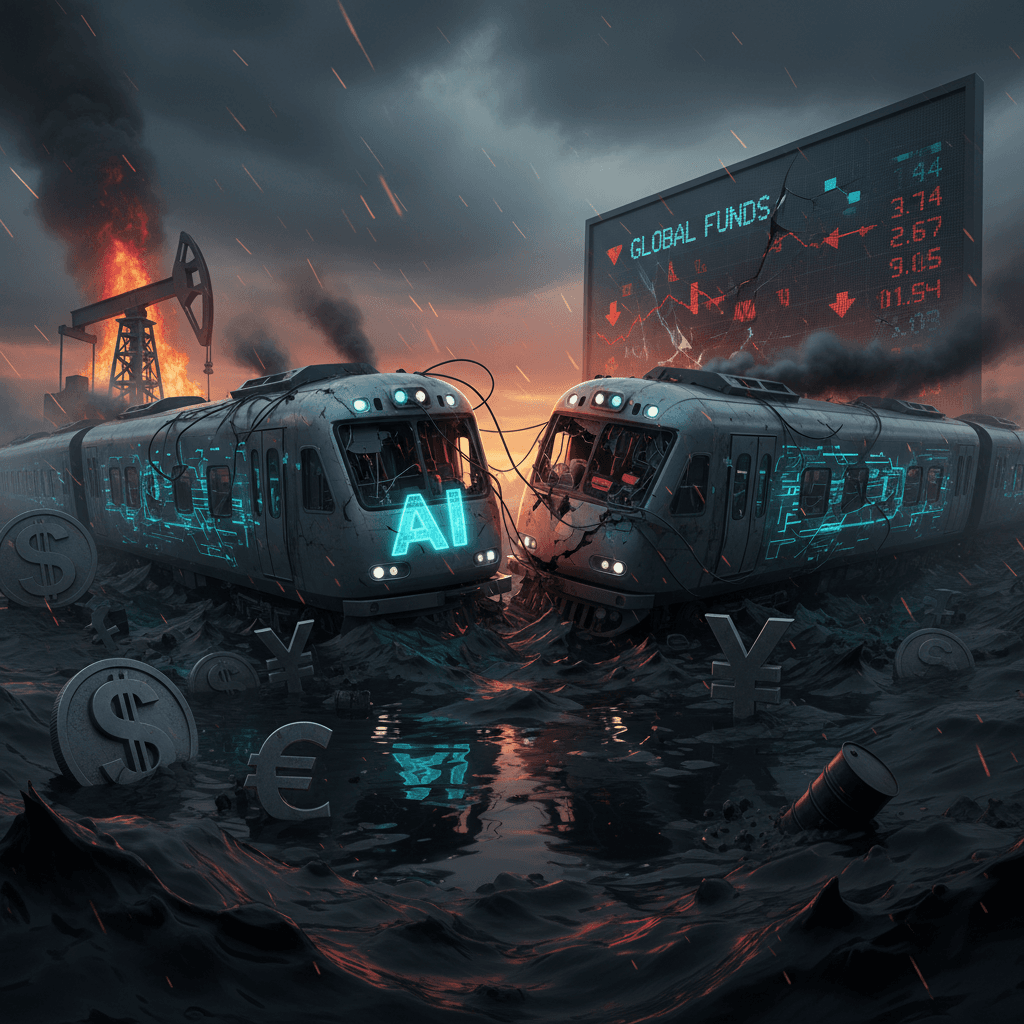
AI's Hype Train Derails as Oil Fears Spook Global Funds
ECONOMYBloomberg

AI's Hype Train Derails as Oil Fears Spook Global Funds

DP
Daniel Park

Economy & Markets Editor

·5 min read·955 words
fundsglobalenergyrotationtech
Share:

The everything-goes-up AI party just got a bucket of cold, crude oil thrown on it. For the last 18 months, the only trade that mattered was piling into anything that smelled like a large language model. Now, the biggest players on Wall Street—the multi-trillion-dollar global funds—are quietly heading for the exits. They’re not cashing out because AI is a bust. They’re cashing out because the real world, with its messy geopolitics and finite resources, just reminded everyone that servers don’t run on hype.

This isn't just another market rotation. It's a fundamental collision between the digital and physical worlds. The infinite, exponential growth curve of AI just slammed into the very finite, very political reality of a barrel of oil.

Why This Matters to Your Portfolio (and Your Job)

If you think this is just a problem for hedge fund managers in Greenwich, you haven't been paying attention. This shift has tentacles that reach right into your 401(k), your company's stock plan, and the entire venture capital climate that funds the next generation of startups.

For years, the mantra in tech was simple: growth at all costs. Burn cash, capture market share, and the profits will eventually follow. That works when money is cheap and the inputs—electricity, components, talent—are predictable. That era is over. With Brent crude futures pushing past $105 a barrel, the operational cost of running massive AI data centers is no longer a footnote on a balance sheet. It’s the headline.

I’ve seen this movie before, just with a different cast. Back in the dot-com bust, it was the companies that had actual business models—not just eyeballs—that survived. This time, it’s about efficiency. The pressure is on for AI companies to prove their models can generate more value than the staggering electricity bill they rack up. For anyone holding tech stocks, especially those RSUs you were banking on, this sudden focus on profitability is a rude awakening. It’s a market that’s suddenly asking hard questions, much like the ones that led to the Fed's recent surprise that torched tech compensation packages.

What Is Global Funds Management and Why Does It Matter Now?

So, who are these mysterious "global funds" causing all the trouble? Think of them as the supertankers of the financial ocean. They aren't nimble speedboats trying to catch a hot trend. They are pension funds, sovereign wealth funds, and massive asset managers like BlackRock and Vanguard. They manage trillions of dollars in retirement savings for millions of people. Their primary job isn't to gamble; it's to preserve and grow capital steadily and safely.

When these giants decide to move, they don't do it quickly, and they don't do it on a whim. Their shift from AI darlings to boring old energy stocks is a tectonic event. It signals a broad, institutional-level change in risk assessment. They're looking at the world and concluding that the guaranteed demand for energy in an unstable world is a safer bet than the projected future profits of an AI company with a massive energy bill.

It’s a vote of no confidence, not in the technology itself, but in the idea that the tech can remain magically insulated from real-world economics. They’re the adults who walked into the teenager’s house party and just cut the power.

A Timeline of the Great AI Rotation

This didn't happen overnight. It was a slow-burn realization that culminated in a rapid unwinding. Here's how we got here:

  1. The Nvidia Singularity (Q4 2024 - Q1 2026): For over a year, Nvidia could do no wrong. Its GPUs became more valuable than gold, and its stock chart looked like a rocket launch. This euphoria created a halo effect, lifting every company with ".ai" in its mission statement. It felt unstoppable, but as some of us suspected, there was always a potential trap inside those record-breaking quarters.
  2. The Inflation Ghost (February 2026): The first warning shots. Inflation data came in hotter than expected, driven by rising energy and logistics costs. The Federal Reserve made it clear that the fight wasn't over. This made the "growth now, profits later" story much harder to sell.
  3. The Strait of Hormuz Incident (Early March 2026): This was the catalyst. A minor naval skirmish—quickly de-escalated—was all it took. It was a stark reminder of the fragility of global oil supply chains. Oil prices jumped 8% in 48 hours, and the risk models inside every global fund flashed red.
  4. The Great Unwinding (Now): The aftermath. We're seeing what analysts at Goldman Sachs are calling a "$300 billion rotation" out of tech and into energy and industrial sectors. The momentum trade that powered AI stocks for 18 months has violently reversed.

Are Global Funds a Good Investment in This Climate?

The question isn't just about whether to follow the big money into energy, but understanding why they're moving. This is a classic flight to safety, but with a modern tech twist.

I like to think of it like this: for the last two years, the market was a fantasy RPG where everyone poured their skill points into the "Intelligence" and "Magic" stats (AI, software). It was devastatingly effective. But the game masters just released a new world boss—Geopolitical Instability—that has 90% resistance to magic but is incredibly vulnerable to physical damage.

Suddenly, everyone is scrambling to respec their character. They're pulling points out of "AI" and dumping them into "Strength" and "Stamina" (Energy, Commodities, Industrials). It’s not that magic is useless; it’s just that the current environment demands a different strategy.

This is the market re-learning a lesson I picked up after pulling too many all-nighters in freezing data centers: technology is, and always has been, a deeply physical enterprise. Code is just stored magnetic charges. A model is just

Related Articles