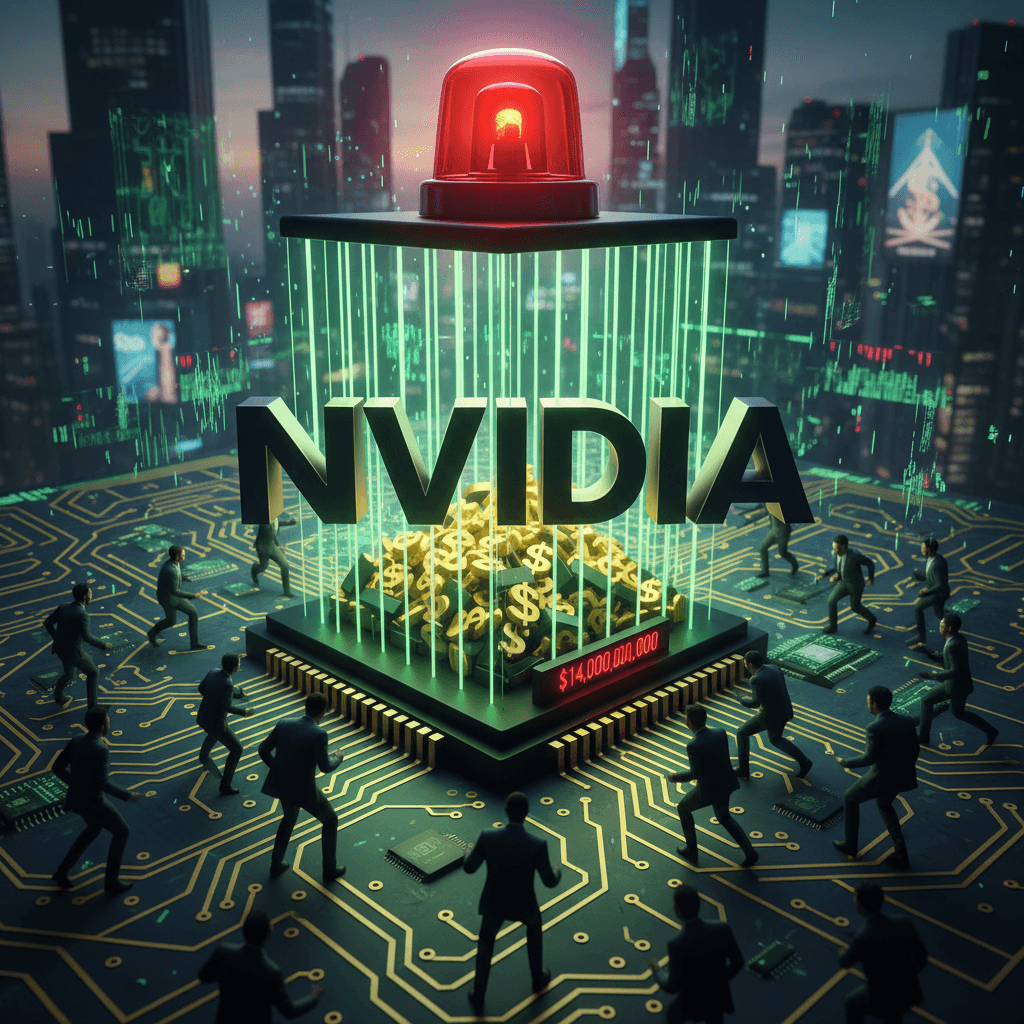
The $14B Trap Inside Nvidia's Record Quarter

The $14B Trap Inside Nvidia's Record Quarter

Alex Chen
Alex Chen

Senior Tech Editor

·5 min read·943 words
nvidiaciscocompanycapexbuilding
Share:

The Day the Shovel-Seller Bought the Mine

I still remember my first real GPU. It was a chunky, dust-gathering GTX 970 that I bought with three months of tip money from a barista gig back in 2014. I was completely unaware that the company making my Skyrim frame rates tolerable would eventually eat the global economy.

Back then, Nvidia was just a hardware company for gamers and graphic designers. Today? They are effectively a sovereign nation state.

If you looked at the headlines this morning, you saw the victory lap. As first reported by TechCrunch, Nvidia just posted yet another mind-melting earnings report for early 2026. The top-line numbers are the kind of figures that make Wall Street analysts weep with joy: $42.5 billion in quarterly revenue, utterly crushing expectations. Again.

But I spent the morning digging through the actual earnings transcript, and I found a number that made me spill my coffee. It’s not the revenue. It’s the money going out the door.

Nvidia just dropped a staggering $14.2 billion on capital expenditures (capex) in a single quarter. That’s a 68% year-over-year jump. And it tells a completely different story about where the AI boom is actually heading.

The "So What?" Context: Why Heavy Metal Matters

So why does a boring accounting term like "capex" matter to you, someone who probably just wants AI tools that don't hallucinate legal precedents or generate hands with seven fingers?

Because capex is physical reality. It’s concrete, copper, cooling systems, and land.

For the past three years, the dominant narrative was beautifully simple. Nvidia was the ultimate "picks and shovels" play in the AI gold rush. They didn't have to build the gold mines (the massive AI data centers). They just sold the incredibly expensive shovels (the H100 and Blackwell chips) to companies like Microsoft, Meta, and Google at an astronomical 75% gross margin.

But this new capex figure breaks that narrative into tiny, expensive pieces. Nvidia isn't just selling shovels anymore. They are frantically buying up the mountain.

According to recent supply chain analyses from Reuters, Nvidia is quietly securing massive swaths of data center space, investing heavily in next-generation liquid cooling infrastructure, and essentially building their own supercomputing cloud. They are transforming from a fabless chip designer into a heavy-infrastructure utility company.

The Contrarian Angle: This Isn't Dominance. It's Defense.

Mainstream financial networks are spinning this capex spend as a flex. "Nvidia is so rich they can out-build their own customers!"


I see it differently. I think it's a panic move. A highly calculated, incredibly well-funded panic move.

Here is the terrifying reality keeping Jensen Huang awake at night: what happens when the hyperscalers stop buying?

Right now, a handful of tech giants account for nearly half of Nvidia's data center revenue. These companies are locked in a desperate arms race, hoarding GPUs like toilet paper in 2020. But eventually, the music stops. Meta's shareholders will eventually demand a return on the billions Mark Zuckerberg is burning on compute. Microsoft will eventually realize they have enough silicon to train GPT-6, 7, and 8.

We've talked before about Nvidia’s bizarre $3.6T valuation, but this earnings call fundamentally changes the math. By building their own massive AI cloud infrastructure (DGX Cloud), Nvidia is creating a safety net. When their biggest customers inevitably slash their hardware budgets, Nvidia will simply pivot to renting out their own compute directly to enterprise clients.

They are building a lifeboat. A $14 billion lifeboat.

The Ghost of Cisco Past

If you want to understand what's happening right now, you have to look backward. The last time we saw a single hardware vendor dominate a technological revolution this thoroughly was the year 2000.

During the dot-com boom, Cisco was the Nvidia of its day. They built the routers and switches that physically held the internet together. Every telecom company on earth was buying Cisco gear with blank checks. Cisco briefly became the most valuable company on the planet.

Then the telecom companies overbuilt. They realized they had laid too much fiber and bought too many routers. The orders stopped overnight. Cisco's stock price evaporated, dropping nearly 80%, and it took them two decades to recover.

Compared to Cisco's fatal hubris, Nvidia's current strategy is actually brilliant. Cisco just kept building routers until the cliff appeared. Nvidia sees the cliff coming, so they are using their current windfall to build a parachute. They are investing their capex in areas that ensure they remain indispensable.

Where the $14B is Actually Going:

  • Advanced Liquid Cooling: As Wired recently highlighted, next-gen chips run so hot they are literally melting standard server racks. Nvidia is heavily subsidizing the R&D for entirely new thermal management systems.
  • Custom Networking: They aren't just making the brains; they are making the nervous system. Their InfiniBand networking gear is eating into traditional data center budgets.
  • Energy Procurement: You can't run a supercomputer without power. Nvidia is increasingly involved in the actual energy logistics required to keep these AI grids online.

Editor's take: This is where I feel a twinge of nostalgia-laced bitterness. As someone who grew up in the PC building community, watching Nvidia morph into a B2B infrastructure behemoth feels like watching your favorite indie band sell out to make stadium-rock anthems for pharmaceutical commercials. The consumer gaming market that built this company is now barely a rounding error in their SEC filings. We aren't the main characters anymore. We aren't even NPCs. We're just the dust on the server racks.

The Future Impact: What Happens When the Bubble Solidifies

Stop waiting for the AI bubble to "pop" in a spectacular, fiery explosion. That's not how this ends. Bubbles don't always

Related Articles