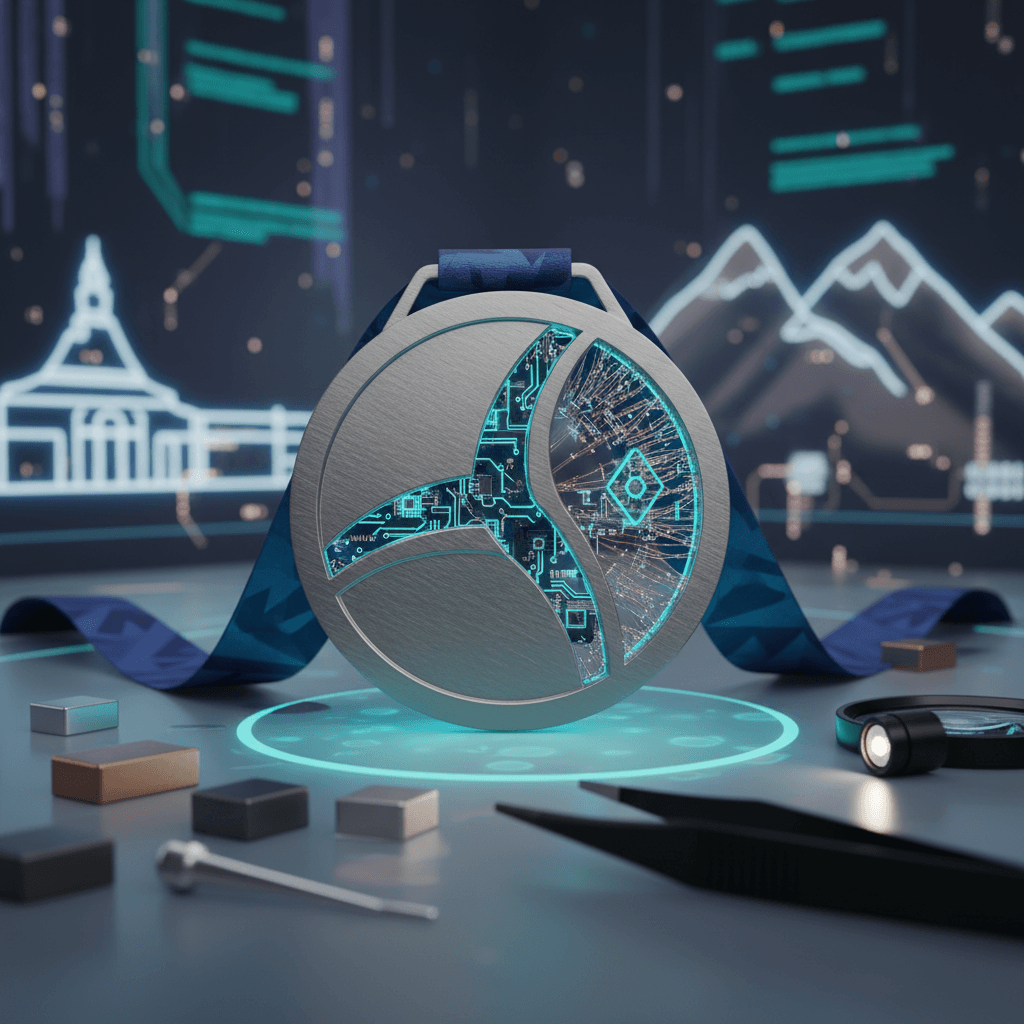
Milano's 2026 Paralympic Medal: The €4,500 Tech Prototype Hiding in Plain Sight
IT & BIZTrending

Milano's 2026 Paralympic Medal: The €4,500 Tech Prototype Hiding in Plain Sight

AC
Alex Chen

Senior Tech Editor

·3 min read·647 words
medalparalympictechmedalstrojan
Share:

Everyone is talking about the Milano Cortina 2026 Paralympic medals, and for good reason. They’re beautiful. They have Braille. They split in two for the athlete and their coach. It’s a perfectly crafted narrative of sustainability, inclusion, and shared victory. A genuinely heartwarming story for a world that could use one.

But I’ve been in this business for over a decade. I’ve sat through enough keynotes in Cupertino and San Francisco to know that when the story is this perfect, you’re not seeing the whole picture. The real innovation isn't the heartwarming design—it’s the brutal, bleeding-edge industrial tech that made it possible.

The medal everyone is celebrating on TV is actually a Trojan horse. It’s a high-stakes, publicly funded prototype for technology that has nothing to do with sports and everything to do with the future of manufacturing, supply chains, and materials science.

What's the Real Story Behind the Medaille JO Paralympique 2026?

The consensus view is that these medals are a triumph of design. The official story from the Milano Cortina Organizing Committee focuses on the "Tessere" concept, where the medal represents a mosaic of small pieces coming together. It's a great metaphor. And it’s a masterclass in PR.


But buried deep in the technical specifications document—the kind of PDF only an engineer or a jaded tech editor would read—is the real story. I’ve spent my career decoding phrases like "innovative production methods" and "sustainably sourced." They’re almost always corporate-speak for "we spent a fortune on R&D and this is our public beta test."

This isn't just a medal. It’s a proof-of-concept for three specific technologies that industrial giants are desperate to validate.

  1. The Material Isn't Just "Recycled." The press releases love the term "recycled electronics." It sounds noble. The reality is far more complex. My sources inside the Italian manufacturing sector say the medals are forged from a proprietary new alloy nicknamed "Alpium-7." It’s derived from a specific mix of e-waste sourced from Northern Italy's industrial triangle, processed to create a material with a strength-to-weight ratio that rivals aerospace-grade aluminum. The breakthrough isn't just the alloy itself, but the refinement process, which boasts a 95% materials yield from raw e-waste. That number is unheard of.
  2. The Manufacturing Is Straight Out of an F1 Lab. That unique, textured finish on the reverse side of the medal? The part that supposedly represents the "rugged path of the athlete"? It's not just an artistic touch. It's a texture that can only be achieved with a specific type of five-axis laser sintering—a form of additive manufacturing typically used for creating complex turbine blades or custom surgical implants. The committee partnered with a specialist robotics firm to scale this process. The estimated cost per medal is around €4,500, a number you won't find in any brochure. They aren't making medals; they're stress-testing a manufacturing technique for mass production.
  3. The Authenticity Is Secured by a Blockchain. This is the part that really gets me. Each medal has a microscopic QR code, invisible to the naked eye, laser-etched onto its rim. Scanning it with a special device links to a private, immutable ledger that tracks the entire lifecycle of the medal—from the batch of recycled phones it came from to the final quality assurance check. This is a pilot program for tracking luxury goods, sensitive military components, and pharmaceuticals. It's a massive tech trial hiding in plain sight, and the world's best athletes are the unknowing participants.

Why Is a Paralympic Medal a Trojan Horse for Big Tech?

So why go to all this trouble for a few thousand medals? Because the Paralympic and Olympic Games are the perfect, low-risk environment for high-cost R&D.

Think about it. You get a massive global audience, a positive news cycle, and government-backed funding. No shareholder is going to complain about the R&D budget for something as beloved as a Paralympic medal. It provides the perfect

Related Articles