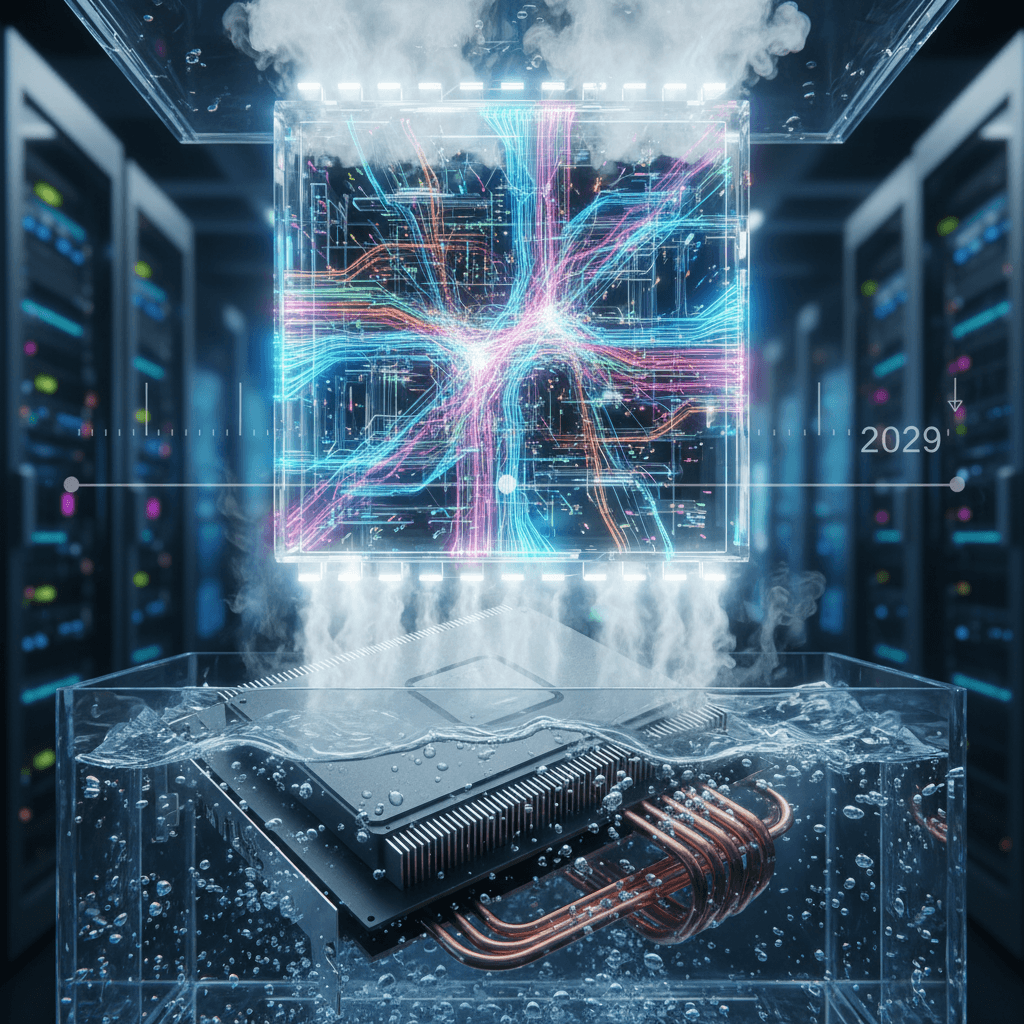
The $7T Silicon Wall: Why AI's Next Brain Runs on Light
TECHNews

The $7T Silicon Wall: Why AI's Next Brain Runs on Light

Alex Chen
Alex Chen

Senior Tech Editor

·5 min read·1028 words
memorymassivelightcurrentlyphotonic
Share:

The Brute Force Problem on Your Desk

If you're running a heavy local LLM or pushing a high-end gaming rig right now, listen to your machine. Those cooling fans screaming like a jet engine on the tarmac? That’s the sound of physics begging for mercy.

We are currently trying to build artificial human intelligence using glorified rocks and electricity. And we are hitting a massive, incredibly hot wall. The tech industry's answer to the AI boom has basically been to throw more power at the problem. Build bigger data centers. Hoard more Nvidia GPUs. Burn more coal.

But a fascinating new breakthrough reported by Phys.org outlines a completely different path forward: making computers "think" using light instead of electricity. Specifically, researchers are successfully bridging the gap between photons and artificial memory, creating systems that mimic the human brain's neural networks but operate at the speed of light.

It's brilliant. And honestly? It's about time we stopped trying to brute-force our way to AGI.

The "So What?" Context: Breaking the Bottleneck

To understand why this matters, you have to understand why current computers are so wildly inefficient at AI tasks. Since the 1940s, we've built machines using the von Neumann architecture. In plain English: the part of your computer that stores data (memory) and the part that crunches data (the processor) are two separate physical places.

Every single time your computer wants to do math, it has to physically shuttle electrons back and forth between the memory and the processor. This commute is called the von Neumann bottleneck. For standard computing—like rendering a spreadsheet or loading a YouTube video—it's fine. But for AI, which requires referencing billions of parameters simultaneously, it's a disaster.

Your actual, biological brain doesn't work this way. Your synapses handle memory storage and processing in the exact same spot. It's why your brain runs on roughly 20 watts of power—about enough to power a dim lightbulb—while a massive ChatGPT server farm requires gigawatts.

Photonic memory changes the math entirely. By using phase-change materials (similar to what used to be in rewritable CDs) combined with microscopic silicon waveguides, scientists are creating artificial synapses. When you shine a laser pulse through it, it changes the optical properties of the material, "remembering" the data. No moving electrons. No massive heat generation. Just light.

The Data We Can't Ignore

Let's look at the actual numbers, because the current trajectory is unsustainable.

  • According to recent data highlighted by Reuters, data centers currently consume an estimated 460 terawatt-hours of electricity globally. That's expected to double by 2026.
  • Moving data between memory and processing currently accounts for up to 80% of the energy consumed in AI workloads.
  • Photonic processors have demonstrated the potential to perform matrix multiplications—the core math behind AI—up to 1,000 times faster than traditional electronic chips.

We are spending billions to cool down chips that are wasting 80% of their energy just moving data across a few millimeters of silicon. It's absurd.

The Angle Everyone is Missing

Mainstream tech coverage is entirely obsessed with the software layer right now. Every week there's a new benchmark brag from OpenAI or Google. But the real war isn't in the code; it's in the substrate.


When Sam Altman pitched his wild idea to raise trillions of dollars to rebuild the global semiconductor industry, everyone balked at the price tag. But almost nobody questioned the underlying assumption: that we just need *more* traditional silicon. As I noted in Sam Altman’s Caloric Deflection: Why AI Isn't a Human, the industry is stuck in a paradigm of scaling up a fundamentally flawed architecture.

The contrarian truth? The future of AI hardware doesn't belong to the company that can pack the most microscopic transistors onto a silicon wafer. We are already hitting the quantum limits of how small transistors can get before electrons start teleporting across barriers (quantum tunneling). The future belongs to whoever can commercialize neuromorphic engineering using light.

A Precedent Written in Vacuum Tubes

We've been here before.

In the 1950s, the computing industry was hitting a physical wall with vacuum tubes. They were huge, they generated massive amounts of heat, and they burned out constantly. If you wanted a more powerful computer, you had to build a bigger room and install better air conditioning. Sound familiar?

The invention of the solid-state transistor didn't just iterate on the vacuum tube. It replaced the underlying physics of the switch. It made computers small enough to go to the moon, and eventually, into our pockets.

We are currently in the "vacuum tube" era of artificial intelligence. We are building massive, hot, fragile monoliths. Photonic memory is our transistor moment.

Editor's take: What excites me most about this isn't just the speed—it's the democratization. Right now, only trillion-dollar mega-corporations can afford to train frontier AI models because only they can afford the energy bills. If photonic chips can drop the energy requirements of AI by orders of magnitude, we move from an era of centralized, cloud-based AI overlords to incredibly powerful, localized AI running on your personal devices without draining your battery in ten minutes.

We're already seeing whispers of this shift. Major tech publications like Wired have begun tracking the quiet influx of venture capital moving away from traditional silicon startups and into optical computing.

The Specific Downstream Impact

So where does this actually leave us?

The transition from lab breakthrough to consumer hardware is always agonizingly slow, but the financial incentives here are too massive to ignore. The hyperscalers (Amazon, Google, Microsoft) are desperate to cut their energy costs.

Here is my specific prediction: By Q3 2028, we will see the first major commercial integration of a photonic co-processor in a consumer device—likely a high-end Apple or Qualcomm mobile chip dedicated entirely to localized AI processing.

For professionals in the hardware engineering and data center architecture space, this signals an impending bloodbath for traditional cooling and power-delivery infrastructure. The companies currently making billions selling liquid cooling systems for server racks? Their core product is going to become obsolete the moment light-based chips hit commercial scale.

We are about to stop thinking with electricity, and start thinking with light. And honestly, it can't happen fast enough.

Related Articles