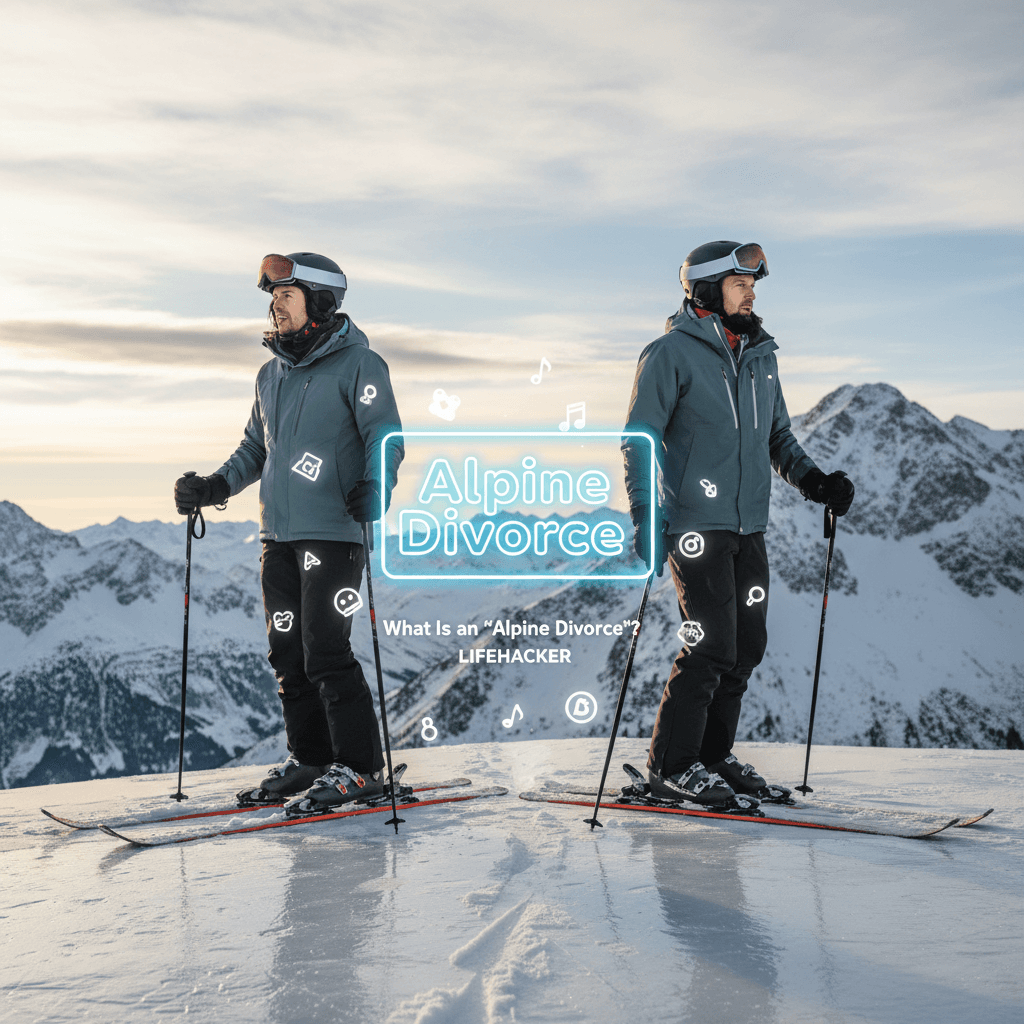
The Out-of-Touch Adults' Guide to Kid Culture: What Is an 'Alpine Divorce'? - Lifehacker

The Out-of-Touch Adults' Guide to Kid Culture: What Is an 'Alpine Divorce'? - Lifehacker

MR
Maya Rodriguez

Culture & Entertainment Editor

·6 min read·1174 words
slangculturedigitalalpinedivorce
Share:
TITLE: 'Alpine Divorce' & The Memes That Broke Language META: An 'Alpine Divorce' is Gen Z slang for a breakup on a ski slope. Here's what it reveals about TikTok's algorithm, micro-cultures, and the future of communication. CATEGORY: CULTURE

I spend my days staring at codebases and product roadmaps. I’ve sat through enough 3-hour keynotes about synergistic paradigms to know corporate jargon when I see it. But the term that really stopped me in my tracks this week wasn’t from a Series C pitch deck. It was "Alpine Divorce."

It sounds like a bad indie film from the 90s. The kind with a lot of silent, snowy landscapes and emotionally repressed characters. But it’s not. It’s a piece of hyper-specific slang, born on TikTok, to describe the act of breaking up with someone on a ski trip, where one person skis away dramatically, leaving the other stranded at the top of the mountain.

Yes, really.

My first reaction was a cynical laugh. My second was a familiar feeling—the one I get when I see a startup burn $50 million on a problem nobody has. But the more I thought about it, the more I realized this wasn't just another silly meme. It’s a perfect data point illustrating a fundamental restructuring of how culture is built and disseminated in 2026. This isn't about kids being weird; it's about the platform dynamics that reward this exact kind of weirdness.

An Out-of-Touch Adult's Guide to Digital Culture

Let’s get the basics out of the way. A term like "Alpine Divorce" doesn't bubble up from schoolyards or MTV anymore. It’s manufactured on a digital assembly line. The process is brutally efficient.

  1. The Spark: Some poor soul posts a video—maybe real, maybe staged—of their own mountaintop dumping. It’s visual, emotional, and has a clear narrative arc.
  2. Algorithmic Amplification: TikTok's engine, a system more attuned to human psychology than most therapists, detects a spike in engagement. It sees high watch time, comments, shares. It pushes the video to more "For You" pages.
  3. Replication and Codification: Other creators, hungry for engagement, replicate the format. They create skits, tell their own stories, or use the audio. Somewhere in this chaotic churn, a clever comment names the phenomenon: "Alpine Divorce." The name sticks because it's evocative and niche. It feels like an inside joke.
  4. Saturation and Burnout: The term explodes. For about three weeks, it's everywhere. Then, just as quickly, the algorithm gets bored. The engagement rate flattens. The assembly line moves on to the next shiny object.

This entire cycle can happen in less than a month. Compare that to slang from my high school days. A term like "crunk" or "that's hot" had a cultural lifespan measured in years, propagated slowly through mass media. Today's micro-slang has the half-life of a fruit fly. It's a feature, not a bug, of a system designed to keep you scrolling. As TechCrunch has reported for years, the goal isn't stickiness to a single piece of content, but to the feed itself.

This relentless churn creates a kind of linguistic planned obsolescence. It’s why trying to keep up feels impossible. You’re not just learning a new word; you’re trying to catch a specific frame of a movie that’s playing at 1,000x speed.

So, Why Does Your Teenager Stay in Their Room (And Speak in Code)?

The easy answer is "the internet." But that's lazy. It’s like blaming a bug on "the computer." The real reason is that these digital spaces are where this high-speed language evolution is happening, and it serves a powerful social function: creating in-groups.

When I was debugging a nasty multithreading issue at 2 AM with a fellow engineer, we used shorthand: "race condition," "deadlock," "atomic swap." It was efficient. It also instantly signaled that we both understood the complex system we were working in. Anyone listening in would be lost.


That’s what "Alpine Divorce" is. It’s not just a funny phrase. It’s a password.

If you get it, you’re part of the club. You’re fluent in the constantly-updating OS of online culture. If you don't, you're an outsider—an adult, a "normie," someone who probably still has a Facebook account. This is a powerful driver of community for a generation that builds identity online. These terms are the digital equivalent of wearing the right band t-shirt. It's a core reason why the cultural half-life of digital trends seems to be shrinking every year.

This linguistic gatekeeping is far more sophisticated than the pig Latin of our childhoods. It’s tied to complex layers of irony, self-reference, and knowledge of a thousand prior memes. The barrier to entry isn’t memorizing a word; it’s having the 10,000 hours of screen time required to understand its context.

Editor's Take: This Is More Than Slang—It's a New Syntax

Here’s the part that most "what are the kids saying" articles miss. They treat these terms as isolated vocabulary words. They’re not. They represent a shift in the syntax of communication itself. It’s a move toward context-heavy, information-dense packets of meaning.

"Alpine Divorce" conveys not just an action, but a whole aesthetic and emotional state: the privilege of a ski trip, the melodrama of a public breakup, the specific visual of someone literally moving on, the inherent dark comedy. You can't get all that from "we broke up." It's a lossy-to-lossless compression algorithm for human experience. This is why it feels so potent to those who get it and so baffling to those who don't. We're not just witnessing new slang; we're witnessing the beta test of a new, more efficient, and more exclusionary form of language.

The Memeification of Everything

This phenomenon isn't limited to breakups on ski slopes. It's happening to every conceivable human interaction. There are hyper-specific terms for the anxiety of waiting for a text back ("delusionship"), for a low-key style of showing off ("silent flexing"), and for the act of rotting in bed all day ("bed rotting"). Each one is a tiny, shareable, algorithmically optimized package of a relatable feeling.

This is the logical endpoint of a culture mediated by platforms. To exist, an experience must be communicable. To be communicable, it must be packaged. To be packaged, it needs a name. And to get a name, it needs to perform well on the content assembly line. As a result, life itself is being reframed into a series of potentially viral moments. It’s a strange feedback loop where the language we use to describe our lives begins to dictate the lives we live.

It’s no wonder these trends are often linked to consumption. The "Coastal Grandmother" aesthetic wasn't just a vibe; it was a shopping list of linen pants and white wine that drove millions in e-commerce sales. The "Unspoken Rizz" meme became a masterclass in subtle body language that people tried to emulate. Even the original Lifehacker article positions itself as a guide for the confused, a service for those outside the cultural firewall.

The speed of this process is what separates it from the past. According to Statista, TikTok users spend an

Related Articles